


From architecture to deployment, the execution was flawless. They didn't just write code; they challenged our assumptions and built a significantly better fintech product.



App Deft builds secure, scalable blockchain and Web3 solutions smart contracts, decentralised applications, token wallets, and payment infrastructure with security review built into the process rather than bolted on before launch.
Free 30-minute technical call. You leave with an honest answer on whether blockchain is the right architecture for your problem, and what it would cost if it is.
Trusted by our partners



Most blockchain projects that fail were decided before a line of code was written. We start with the architecture question, not the implementation.

Four solution types cover most of what clients come to us for. If yours is not here, describe the problem and we will tell you whether chain architecture fits it.

Minting, marketplace, royalty logic, and custody for digital assets and tokenised ownership records. Built with the metadata and transfer rules your legal position requires, not a template contract copied from a public repository.

Contribution logic, vesting schedules, refund conditions, and investor dashboards. Every contract path is tested against the failure cases that cost projects their funds: reentrancy, rounding, and access control.

Custodial and non-custodial wallets with multi-signature approval, key recovery, and transaction signing flows your users can complete without support tickets.

Stablecoin and token payment rails, on-chain settlement, and reconciliation that connects to the accounting system your finance team already uses.
Each of these starts with a real operational cost: reconciliation, disputes, manual verification, or a trust gap between parties who do not share a system.

When two parties keep separate records, someone pays for the reconciliation. A shared, tamper-resistant ledger removes the dispute before it starts, with every transaction traceable to its origin.

Ownership records held in spreadsheets and email attachments are difficult to transfer and impossible to prove. Tokenised assets carry their own provenance and transfer history.

Agreements that require someone to check a condition and then trigger a payment become contracts that execute themselves when the condition is met, with no intermediary and no delay.

Applications where users will not accept a single operator holding all control and all data. We build dApps where the rules are visible and the user keeps custody.

Organisations that must share data but cannot share a database. Permissioned ledgers let each party verify what they need without handing over the underlying records.

Repeated identity checks across partners cost time and create duplicate stores of personal data. Verifiable credentials let a user prove a claim once and reuse it.
We recommend the chain that fits your cost, throughput, and compliance requirements — not the one with the best conference presence. EVM chains for ecosystem access, Solana for throughput, Hyperledger for permissioned enterprise networks
 Ethereum
 Polygon
 Hyperledger
 Solana
 Avalanche
 BNB Chain
 Arbitrum
 Optimism
 Cosmos
 Substrate
Smart contract code is public and permanent. That changes how it has to be built.

Every contract is reviewed for reentrancy, access control, and oracle risks before it reaches a network, and we coordinate the external audit when your contracts hold value.
We build to support your compliance obligations. Certification and legal sign-off remain yours, and we will say so in writing.

Personal data stays off chain by design. We store references and proofs on chain and keep the underlying records in systems where deletion and access requests can actually be honoured.

For health data, we architect permissioned access, audit trails, and encrypted off-chain storage that supports your covered-entity obligations.
Payment flows are designed so cardholder data never touches chain infrastructure, reducing the scope your assessor has to review.

Transaction monitoring hooks, wallet screening integrations, and reporting exports built into the product rather than added under pressure later.
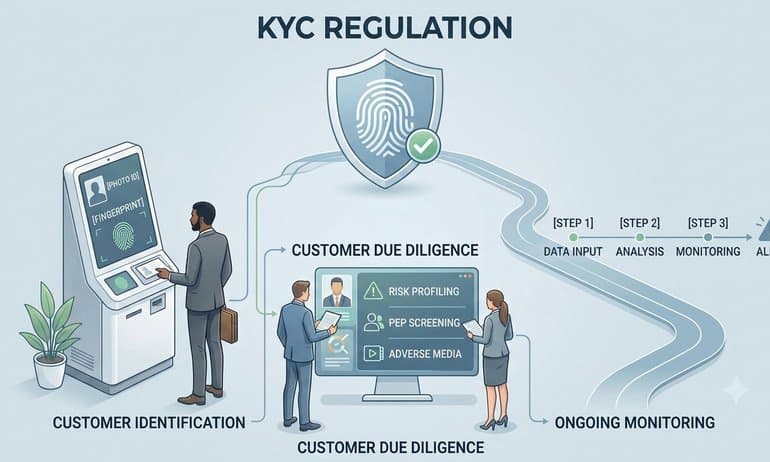
Identity verification flows integrated with established KYC providers, with verification status recorded against wallets and accounts.

Travel rule data handling and counterparty information flows designed into token transfer and payment products from the start.

We follow secure development practices aligned to these frameworks: access control, change management, and documented review.

Internal review against reentrancy, access control, integer, and oracle manipulation risks, plus coordination of third-party audits for contracts that hold value.
Twelve areas where clients ask us to build. Each one starts from a verification, settlement, or provenance problem that conventional systems handle badly.

Consent records and treatment histories that follow the patient across providers, with verifiable access logs and personal data held off chain.

Tamper-evident audit trails for record access and amendment, so every read and change can be proven to an auditor without exposing the record itself.

Settlement, reconciliation, and asset servicing that remove the multi-day gap and the manual matching between counterparties.

Credentials and certifications employers can verify in seconds, issued once and checked without contacting the institution.

Public registries, procurement records, and benefit disbursement with transparent history and controlled write access.

Lending, staking, liquidity, and yield protocols built with audited contracts and an interface non- technical users can operate safely.

Provenance from source to shelf, with each custody transfer recorded by the party that handled the goods rather than reconstructed afterwards.

Asset and equipment histories that multiple organisations can trust: maintenance events, ownership transfers, and certification status in one verifiable record.

Minting, marketplaces, and royalty enforcement for digital collectibles, ticketing, and tokenised memberships.

Title records, fractional ownership, and escrow logic that reduce the paperwork and the intermediary count in a transfer.

Turning real-world assets funds, invoices, commodities, property into transferable tokens with compliance rules written into the contract.

In-game economies with genuine player ownership, secondary markets, and cross-title assets that survive a server shutdown.
You do not need a specification to talk to us. Bring the problem: the reconciliation that takes three days, the partner who will not share a database, the ownership record nobody can prove.
Book a 30-minute call. We will tell you whether a chain solves it, what the architecture would look like, and roughly what it would cost. If a conventional system is the better answer, we will say so.
Schedule a Free Consultation
No commitment. No pitch. A straight answer on architecture and cost.
Real feedback from clients who trusted us to bring their ideas to life.
From architecture to deployment, the execution was flawless. They didn't just write code; they challenged our assumptions and built a significantly better fintech product.
Rakesh and his team did an outstanding job, aligning perfectly with our project objectives and delivering on time. We look forward to collaborating with him on future projects!

I worked with App Deft Team for years as they maintained our WordPress site. They are very proficient as well as a good communicator. I would not hesitate to hire them for projects again. Thanks App Deft!
The engineering depth of Appdeft is top-tier. They translated our complex multi-tenant specifications into production-ready software two weeks ahead of schedule.
From architecture to deployment, the execution was flawless. They didn't just write code; they challenged our assumptions and built a significantly better fintech product.
Rakesh and his team did an outstanding job, aligning perfectly with our project objectives and delivering on time. We look forward to collaborating with him on future projects!
I worked with App Deft Team for years as they maintained our WordPress site. They are very proficient as well as a good communicator. I would not hesitate to hire them for projects again. Thanks App Deft!



Practical thinking for founders and technology leaders making real blockchain decisions
 AI Strategy
 Generative AI
 AI Automation
A single smart contract with a simple interface can be live in 4 to 8 weeks. A full platform contracts, wallet, backend, dashboard, and integrations typically runs 16 to 28 weeks, and an external audit adds two to four weeks depending on findings. You get a specific range after one scoping call.
Describe the process, the parties involved, and what needs to be proven or settled. We will review it and respond within one business day with a clear next step.